



Vapor Barrier Installation in Little Rock: Stop Ground Moisture Before It Reaches Your Slab and Walls
Little Rock sits where the Ouachita foothills drop into the Arkansas River valley, and that geology matters inside your basement. Expansive shrink-swell clay over shale and sandstone on the western hills holds water against foundations after every spring thunderstorm. Older brick cellars in the Quapaw Quarter and MacArthur Park, Craftsman bungalows in Hillcrest, and walk-out lower levels in Chenal Valley and Pleasant Valley all share the same problem: ground moisture vapor migrates through concrete and masonry, no matter how tight the above-grade envelope looks. Vapor Barrier Installation in Little Rock puts a heavy-duty sheet between that moisture and your living space. We install sealed, taped, sump-integrated barrier systems built for this climate, not thin plastic stapled to a joist. If you want to understand the full system first, start with our basement waterproofing overview, then come back to this page for the barrier specifics.
Why Vapor Barriers Matter in Little Rock's Humid Basements
Central Arkansas gets some of the heaviest rainfall in the region, and long humid summers mean the ground under your slab stays damp for months. That moisture does not need a visible crack to enter. It moves as vapor through porous concrete and mortar, condensing on cool basement walls and feeding the musty smell that tells you something below grade is wet. Homes under oaks, hickories, and shortleaf pines in Leawood and Briarwood often show efflorescence on the lower block courses, which is the mineral signature of water wicking through masonry. A properly installed vapor barrier interrupts that path at the wall and slab surface.
- Blocks ground moisture vapor from passing through concrete and masonry walls.
- Reduces condensation on cool basement surfaces during humid Arkansas summers.
- Protects stored items and finished lower-level materials from damp contact.
- Works with your sump system so collected water has a defined path out.
- Creates a cleaner, drier surface that is easier to inspect for new seepage.
If your basement already smells musty or shows white mineral bloom on the block, the barrier is part of the fix, not the whole fix. We will tell you plainly when moisture control calls for drain tile first.
Key info: A 1920s Craftsman in Hillcrest with a damp block wall and efflorescence on the lower courses usually needs a sealed wall barrier plus corrected grading, not just a coat of sealer. We see this on sloped lots in the Heights and Stifft Station where downspouts dump within three feet of the foundation.
For the official word on construction and alteration permits in the city, check the City of Little Rock building department before any work that changes drainage or structural elements.
How We Install Vapor Barriers in Little Rock Homes
Every installation starts with a free basement inspection so we can see what the wall is actually doing. We check for active seepage, test the sump basin, look at the footing drain condition where visible, and confirm whether hydrostatic pressure is pushing water through the cove joint. Only then do we specify the barrier. On a 1950s brick ranch in Walton Heights with a walk-out lower level, that might mean a dimple board against the wall and a sealed slab sheet tied into the existing sump. On a 1990s Chenal Valley home stepping down the hillside, it often means full wall coverage with taped terminations at the rim joist and a clean sump integration.
- We inspect the basement, sump basin, and visible wall conditions before quoting.
- We clean and prep the wall and slab surfaces so the barrier lays flat and seals.
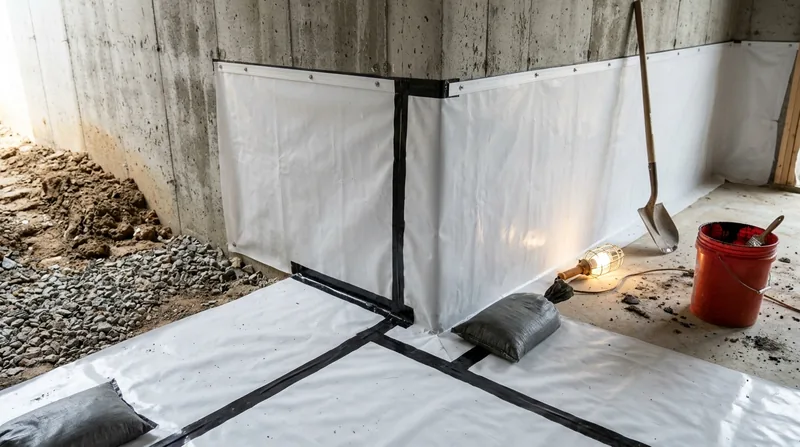
- We install heavy-duty barrier sheets with overlapping seams and taped terminations.
- We integrate the barrier with the sump basin and check valve so water has a clear path.
- We test the system with water before we leave and walk you through what we did.
That sequence keeps the barrier from trapping moisture it was supposed to block. If the inspection shows an active leak at a wall crack, we address it with foundation crack repair before the barrier goes up.
Key info: In a Maumelle walk-out basement, we found the sump discharge line running uphill into the yard. The barrier was fine, but the pump was recycling water. We corrected the discharge and tied the new barrier into the basin in the same visit.
Vapor Barrier Approaches We Use in Little Rock
The right barrier depends on wall type, moisture load, and whether the basement is finished. Here is how the common approaches compare for Little Rock housing stock.
| Approach | Description | Best for |
|---|---|---|
| Wall sheet barrier | Heavy-duty sheet sealed to the wall with taped seams and terminations. | Damp block or poured walls with no active leaking. |
| Dimple board | Drainage mat that holds the barrier off the wall and lets water fall to the drain. | Walls with seepage where an interior drain is also present. |
| Slab vapor barrier | Sealed sheet across the floor with taped overlaps and a sump tie-in. | Finished or semi-finished lower levels over damp slabs. |
| Full wall and slab system | Continuous barrier from rim joist to floor, integrated with sump and drain tile. | Walk-out basements in Chenal Valley and Pleasant Valley. |
We match the approach to the wall, not to a sales target. If a simple wall sheet solves your problem, that is what we quote.
Vapor Barrier Installation Cost in Little Rock: What to Expect
Vapor barrier pricing in Little Rock starts from $3 per square foot installed, and that figure reflects the heavy-duty sheet, sealed seams, taped terminations, and sump integration where needed. The number moves with wall area, access, and how much prep the surface needs. A clean poured wall in a newer Chenal Valley home is straightforward. A 1910s brick cellar in the Quapaw Quarter with lime mortar and uneven courses takes more time to prep and seal correctly. If the inspection shows an active leak or a failed footing drain, the barrier alone will not solve it, and we will tell you that before you spend the money.
Getting two or three estimates is smart on any below-grade work. Ask each contractor what barrier material they use, how they seal seams and terminations, and whether the price includes sump integration. Our full pricing overview lays out the line items so you can compare apples to apples.
Vapor Barrier Installation Near Me: How to Choose a Little Rock Contractor
When you search for vapor barrier installation near me in Little Rock, you will get a mix of dedicated waterproofing specialists, general foundation-repair firms, and handymen. Ask each one the same questions and compare the answers, not the sales pitch. A contractor who cannot explain hydrostatic pressure or the difference between a wall barrier and a slab barrier is not the one for this job.
- Confirm the company is licensed and insured, and ask for a certificate of insurance.
- Get at least two or three written estimates with the barrier material specified.
- Ask for local references from jobs in Little Rock, North Little Rock, or Sherwood.
- Verify whether permits are needed for any drainage or structural work, and who pulls them.
- Check HOA requirements if you live in a planned community in Maumelle or Chenal Valley.
A short conversation with a specialist saves you from paying twice. Reach out through our contact page and we will schedule a free inspection.
Little Rock Waterproofing is a Basement Health Association (BHA) member, and we work below grade only. Call (501) 710-4186 to set up your free basement inspection.
Vapor Barrier Installation in Little Rock: Pricing Guide
| Service | Price | Details |
|---|---|---|
| Wall vapor barrier | Starting at $3/sq ft | Heavy-duty sheet, sealed seams, taped terminations; price rises with wall height and surface prep |
| Slab vapor barrier | Starting at $3/sq ft | Sealed floor sheet with taped overlaps and sump tie-in; moves up with floor area and obstructions |
| Full wall and slab system | On estimate | Continuous barrier from rim joist to floor; needs on-site look at wall type and sump condition |
| Sump integration | Included | Barrier tied into the existing sump basin and check valve when the system is present |
| Travel | Included | in Little Rock and surrounding areas, no separate call-out or mileage fee |
| Estimate | Free | Response within 24h at (501) 710-4186, no obligation to book |
Indicative pricing, the exact cost depends on square footage, finish, and site access. Free personalized estimate within 24h at (501) 710-4186.


