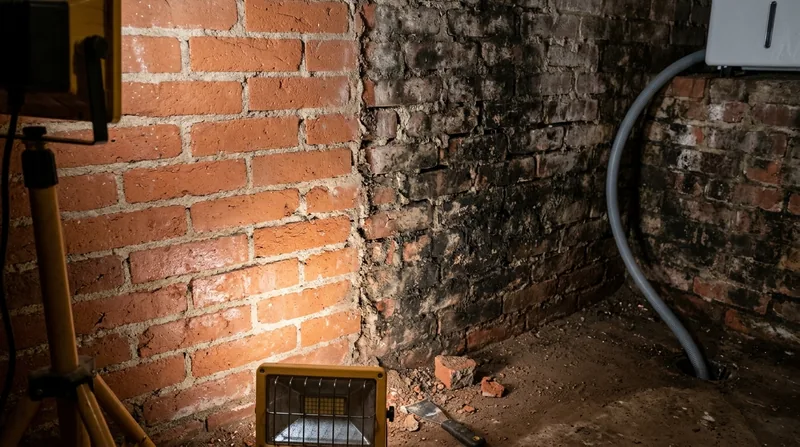




Basement Mold Remediation in Little Rock: Fix the Moisture, Then the Mold
Little Rock sits where the Ouachita foothills drop into the Arkansas River valley, and that geology drives everything we see below grade. Expansive shrink-swell clay over shale and sandstone on the western hills pushes water against foundations all spring, and the river-bottom ground in Riverdale and North Little Rock still carries the memory of the 2019 floods. When Basement Mold Remediation in Little Rock is done right, it starts with finding the water source, not with spraying bleach on the wall.
We handle the containment, the surface treatment, and the moisture fix that keeps growth from returning. That means diagnosing the musty smell first, because a basement that smells like wet earth is telling you where the water is coming in. For the drainage side of the job, see our basement waterproofing service. Call (501) 710-4186 to schedule a look.
Why Basement Mold Grows So Fast in Little Rock's Older Housing Stock
The Quapaw Quarter and MacArthur Park hold 1880s to 1910s Victorian and Queen Anne homes with brick cellars set on old lime-mortar foundations. That mortar is soft and porous, so it wicks groundwater straight into the basement wall. Hillcrest's 1910s to 1940s Craftsman bungalows and Tudors sit on similar footing drains that have long since clogged with roots and silt.
Add Little Rock's long humid summers and spring thunderstorms, and a damp basement never gets a chance to dry out. Mold needs moisture and organic material, and old framing, paper-faced drywall, and stored cardboard supply the second part.
- Efflorescence on the wall is the white salt bloom that proves water is moving through the masonry, not just condensing on it.
- Hydrostatic pressure from saturated clay forces water through hairline cracks and cold joints after every heavy rain.
- Clogged or collapsed weeping tile at the footing lets water pool against the wall instead of draining away.
- A failed sump pump or a discharge line that dumps water back against the foundation turns a dry basement wet in one storm.
Each of those is a moisture source, and none of them goes away because the visible mold was wiped down.
Key info: In the Heights and Stifft Station, homes on sloped lots with partial basements often collect water at the uphill wall. We have pulled saturated drywall from a Heights basement where the only real problem was a downspout dumping at the corner. Extending it ten feet solved more than any surface treatment could.
For the building-science background on moisture and mold in basements, the EPA's mold guidance is a plain-language reference homeowners can read before we arrive.
How We Run a Basement Mold Job in Little Rock, Step by Step
We do not treat mold as a cleaning task. We treat it as a symptom, and we work in order: find the water, stop the water, remove the affected material, then dry and verify. That sequence is what separates a remediation that holds from one that comes back by July.
- We walk the basement and the exterior grade, checking the musty smell, the wall base, the window wells, and the sump basin.
- We set up containment with plastic sheeting and negative air pressure so spores do not migrate into the living space above.
- We remove porous materials that cannot be cleaned, such as saturated drywall, insulation, and swollen baseboards.
- We treat the affected structural surfaces with an antimicrobial application and HEPA-vacuum the space.
- We correct the moisture source, whether that means crack injection, a interior perimeter drain, a sump replacement, or grading and downspout work.
- We run dehumidification and verify moisture readings before we close the job.
The moisture correction is the part that matters most, and it is where we spend the diagnostic time.
Key info: A Chenal Valley walk-out lower level we inspected had mold on the downhill wall only. The uphill side was dry. Water was entering through a window well that filled during storms and draining into the wall cavity. We repaired the well and tied it to the footing drain, then remediated the wall. For that kind of water entry, our window well drainage and repair work is the right starting point.
Matching the Approach to the Moisture Problem
Not every mold job needs the same fix. A single crack that weeps after rain is a different problem from a wall that is wet from the footing up every spring. The table below shows how we match the method to the cause.
| Approach | Description | Best for |
|---|---|---|
| Containment and surface treatment | Sealed work zone, HEPA vacuuming, antimicrobial treatment of structural surfaces | Light surface growth on masonry with a known, fixable water source |
| Material removal and rebuild | Cut out saturated drywall, insulation, and trim, then dry the framing | Finished basements in Walton Heights and Leawood with wet wall cavities |
| Crack injection plus remediation | Epoxy or polyurethane injection closes the leak path, then we treat the wall | Isolated weeping cracks in brick or block foundations |
| Drainage correction plus dehumidification | Interior perimeter drain, sump work, or grading, with controlled drying afterward | Hydrostatic pressure and chronic dampness across the whole wall base |
Basement Mold Remediation Cost in Little Rock: What to Expect
Most basement mold jobs in Little Rock start around $1,500, and that figure covers a defined area of surface growth with a straightforward moisture fix. The number climbs when we have to open finished walls, when the affected area is large, or when the water source turns out to be hydrostatic pressure that needs a drainage system rather than a patch.
Three things move the price most: the square footage of affected material, whether porous finishes have to come out, and how much drainage work the moisture problem requires. A single crack in a Hillcrest bungalow is a small job. A Pleasant Valley walk-out with a wet wall base and a failed sump is a different scope.
We recommend getting two or three written estimates and comparing what each one includes, especially whether the proposal addresses the water source or only the visible growth. Our full pricing overview lays out how we build a quote.
Hiring a Basement Mold Remediation Contractor Near Little Rock
Ask for proof of general liability and workers' compensation coverage before anyone sets foot in your basement, and ask whether the crew is employees or subcontractors. Get the scope in writing, including what gets removed and what gets rebuilt. Call two past customers in similar housing stock, ideally an older home with a brick cellar rather than a newer build.
Permits vary by jurisdiction in the Little Rock metro, and structural foundation repair, egress work, and changes to sump discharge connections can require one. Confirm requirements with the local building department before work begins, and check any HOA rules on exterior drainage changes or discharge locations. Reach us through the contact page when you are ready to schedule.
Basement Mold Remediation in Little Rock: Pricing Guide
| Service | Price | Details |
|---|---|---|
| Surface treatment with containment | Starting at $1,500 | Covers a defined area of surface growth, containment, HEPA vacuuming, and antimicrobial treatment of structural surfaces. |
| Material removal and rebuild | Starting at $2,800 | Adds cut-out of saturated drywall and insulation, framing dry-out, and replacement of removed finishes. |
| Mold plus drainage correction | On estimate | Needed when hydrostatic pressure requires interior drain tile, sump work, or grading before remediation can hold. |
| Travel | Included | In Little Rock and surrounding areas, no separate call-out or mileage fee. |
| Estimate | Free | Response within 24h at (501) 710-4186, no obligation to book. |
Indicative pricing, the exact cost depends on square footage, finish, and site access. Free personalized estimate within 24h at (501) 710-4186.


