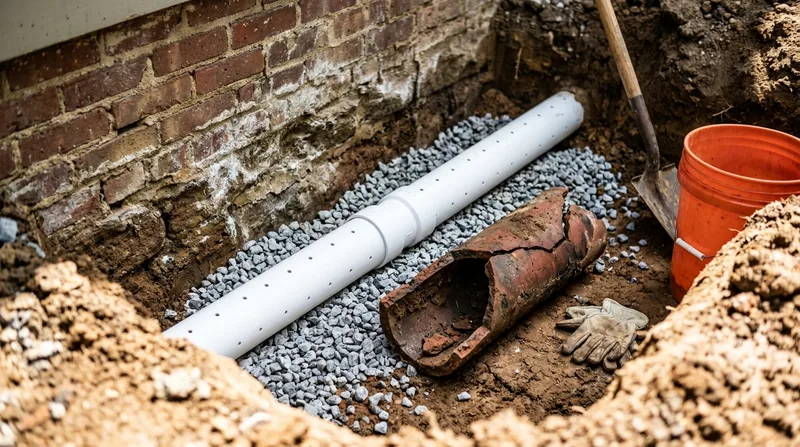




If your basement takes on water after every spring thunderstorm, the problem is usually not the wall itself. It is the drain tile that was supposed to carry that water away. Drain Tile Repair & Replacement in Little Rock targets the footing drain that runs around the base of your foundation, the line that has quietly been failing under Hillcrest bungalows and Quapaw Quarter brick cellars for decades. This city sits where the Ouachita foothills drop into the Arkansas River valley, and that means expansive clay on the western hills, river-bottom ground in Riverdale, and some of the heaviest rain in the region. Original clay tile from the 1910s through the 1950s has collapsed, root-bound, or silted solid across most of the older neighborhoods. We camera the line, find the break, and replace it with modern PVC so water leaves the foundation instead of soaking into it. If you are still sorting out where your water is coming from, start with a free basement inspection before you spend a dollar on repairs.
Why Drain Tile Fails So Often Under Little Rock Homes
The dominant failure mode here is not a crack in the wall. It is a dead footing drain. Homes in the Heights and Stifft Station sit on sloped lots where water sheds fast and loads the drain line from uphill. In Riverdale and the North Little Rock bottoms, the water table rises after a wet spring and the drain has to move water it was never sized for. The 2019 flooding and the March 2023 tornadoes both left behind debris and soil movement that finished off drains already on their last legs.
- Original clay tile joints separate and fill with silt, so the line stops flowing without ever fully collapsing.
- Oak and hickory roots from mature trees find the joints and choke the pipe from the inside.
- Expansive clay soil shifts seasonally and shears the line where it meets the footing.
- Downspouts and grading dump roof water right onto the drain instead of away from the house.
- Older sump basins fill with sediment and the pump burns out trying to move gritty water.
When the drain is dead, hydrostatic pressure builds under the slab and the water finds the easiest path, which is usually the cove joint where the wall meets the floor.
Key info: A 1920s brick cellar in the Quapaw Quarter with a wet floor and efflorescence on the lower wall is almost always a failed clay tile line, not a wall that needs sealing. Sealing that wall without fixing the drain traps the water and pushes it somewhere worse.
Permits for drainage work that alters how water leaves the property vary by jurisdiction, so confirm the current rules with the City of Little Rock Planning and Development Department before work starts.
How We Diagnose and Replace a Failed Drain Tile Line in Little Rock
We do not dig first and ask questions later. The first step is finding out what is actually under your footing, because a 1950s ranch in Leawood and a 2015 build in Chenal Valley have completely different drain assemblies. Camera inspection tells us where the line is broken, root-bound, or silted, and how far the damage runs.
- We camera the existing line from the sump basin or a cleanout and map every break, root intrusion, and low spot.
- We mark the excavation path and check for utilities, irrigation, and mature trees before any soil moves.
- We excavate only the failed run, not the entire perimeter, when the rest of the line tests sound.
- We lay new perforated PVC in a washed gravel bed with the correct fall toward the sump basin.
- We tie the new line into the basin, verify flow with a test run, and restore grade and downspout extensions.
On most jobs we can save part of the original run and only replace the failed section, which keeps the excavation footprint small and the cost down.
Key info: A split-level in Walton Heights had water crossing the lower level every time a storm stalled over the river. The camera showed a 22-foot collapsed run under the uphill footing, choked with shortleaf pine roots. We replaced that section only, re-graded two downspouts, and the lower level has stayed dry through two springs since.
If the camera shows the whole perimeter is gone, an interior drain tile system is often the better answer than tearing up every exterior footing.
Repair Methods We Use and When Each One Fits
There is no single right answer for every house. The method depends on where the break is, how deep the footing sits, and whether the problem is one failed section or a perimeter that never worked. Here is how we match the approach to the job.
| Approach | Description | Best for |
|---|---|---|
| Targeted exterior replacement | Excavate the failed run only and lay new perforated PVC in gravel with correct fall. | One collapsed or root-bound section with a sound remainder. |
| Full perimeter replacement | Replace the entire footing drain around the foundation with new pipe and cleanouts. | Original clay tile that has failed at multiple points. |
| Interior perimeter drain | Cut a channel at the cove joint, install dimple board and drain to a sump basin. | Hydrostatic pressure with no practical exterior access. |
| Sump and discharge upgrade | New basin, pump, check valve, and discharge line routed away from the foundation. | Working drain but a pump that cannot keep up. |
| Camera inspection only | Diagnose the line and document the condition before any excavation decision. | Unclear symptoms or a line that may still be serviceable. |
We tell you plainly when a simple repair will hold and when the honest answer is replacement, and we do not sell excavation you do not need.
Drain Tile Repair & Replacement Cost in Little Rock: What to Expect
Most targeted repairs start at From $750 and climb from there. That figure covers a short failed run, the excavation, new PVC, gravel, and restoration of grade. What moves the number is how much line is gone, how deep the footing sits, and how close the break is to a mature oak, a driveway, or a finished patio that has to come out and go back.
Homes on the river-bottom ground in Riverdale often need a deeper dig because the water table sits higher. Hillside lots in the Heights can need shoring where the slope loads the excavation. A full perimeter replacement on a 1950s ranch is a different job entirely from a 12-foot patch, and we price them differently.
Get two or three written estimates and compare scope, not just the bottom line. A low number that replaces 10 feet of a 90-foot failed line is not a bargain. Our full pricing overview breaks down how we build an estimate.
Hiring a Drain Tile Contractor Near Little Rock: What to Check
Drain tile work is underground, so you cannot see the quality after the backfill goes in. That makes the vetting step the most important part of the job. A contractor who cannot show you a license, insurance, and recent local references is a risk you do not need to take.
- Confirm the contractor is licensed and insured for excavation and foundation drainage work in Arkansas, and ask for the certificate.
- Get at least two or three written estimates that state the linear footage, pipe type, and what restoration is included.
- Ask for references from jobs in Little Rock or North Little Rock done in the last year, and call them.
- Ask who pulls any required permit and confirm the rules with the city before work begins.
- Check for a written transferable warranty on the work, and read what it actually covers.
A straight answer on all five points is what separates a specialist from a general excavator. When you are ready to talk it through, contact us for a free estimate and we will camera the line before we quote a number.
Drain Tile Repair & Replacement in Little Rock: Pricing Guide
| Service | Price | Details |
|---|---|---|
| Targeted drain tile repair | Starting at $750 | Short failed run, excavation, new PVC, gravel bed, and grade restoration included. |
| Sectional replacement | Starting at $1,850 | Longer failed run with multiple breaks, deeper footing, and cleanout installation included. |
| Full perimeter replacement | On estimate | Entire footing drain replaced; price depends on depth, access, and restoration scope. |
| Camera inspection | Starting at $250 | Line diagnosis and written condition report, credited toward repair if you proceed. |
| Travel | Included | In Little Rock and surrounding areas, no separate call-out or mileage fee. |
| Estimate | Free | Response within 24h at (501) 710-4186, no obligation to book. |
Indicative pricing, the exact cost depends on square footage, finish, and site access. Free personalized estimate within 24h at (501) 710-4186.


