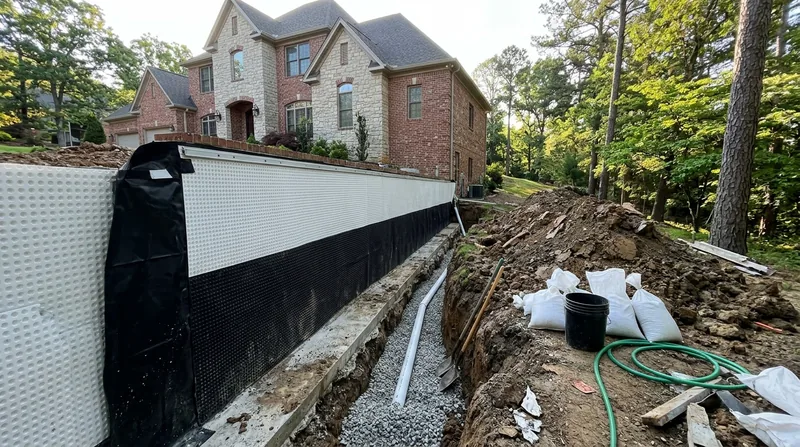




Exterior Basement Waterproofing in Little Rock: Digging Down to the Real Fix
Little Rock sits where the Ouachita foothills drop into the Arkansas River valley, and that geology writes the rules for every basement in the city. On the western hills, expansive shrink-swell clay sits over shale and sandstone, so a heavy spring storm sends water downhill fast and pushes it hard against foundation walls. In Riverdale and North Little Rock, river-bottom ground behaves differently and holds water longer. Homes here are a mix of 1880s brick cellars in the Quapaw Quarter, Craftsman bungalows on sloped lots in Hillcrest and the Heights, 1950s walk-out ranches in Walton Heights, and newer brick homes stepping down the hills in Chenal Valley. Exterior Basement Waterproofing in Little Rock means excavating down to the footing, sealing the wall where the water actually arrives, and correcting the grading and downspouts that feed the problem. We are a Basement Health Association member and a dedicated below-grade specialist, not a general foundation firm. If your wall is seeping after every downpour, start with a free basement inspection so we can tell you whether excavation is truly needed.
Why Uphill Walls in Little Rock Leak After Arkansas Downpours
The dominant failure mode in this city is hydrostatic pressure on the uphill side of a basement wall. When the clay on a Heights or Chenal Valley slope saturates, it stops draining and turns into a loaded sponge pressing against the wall. Water finds the cold joint at the footing, old lime-mortar joints in a Quapaw Quarter cellar, or a hairline crack in a 1960s brick ranch. You see the result inside: efflorescence blooming white on the block, a damp musty smell, or a wet stripe that appears hours after the rain stops.
- Expansive clay soil swells against the wall and relaxes again, working cracks open over the freeze-thaw cycle each winter.
- Original grading often slopes back toward the house, so roof runoff ponds against the foundation instead of leaving the lot.
- Short downspouts dump thousands of gallons within two feet of the wall during a spring thunderstorm.
- Old footing drains in pre-1950 homes are clay tile or collapsed, so the water table rises around the footing with nowhere to go.
- Tree roots from the oaks and hickories that shade these lots can crush or clog an original drain tile line.
When two or more of those conditions stack up, sealing the inside of the wall alone will not hold, and that is when exterior work earns its cost.
Key info: A 1920s bungalow in Hillcrest with a partial basement on the uphill side of the lot is the classic candidate. The clay above the house saturates, the original footing drain is finished, and water shows up at the base of the wall within a day of a two-inch rain. Excavating that uphill wall, membrane and dimple board to the footing, and re-grading the slope is often the only fix that stops it for good. Rules on drainage alterations vary, so confirm with the City of Little Rock building department before work begins: littlerock.gov.
How We Run an Exterior Waterproofing Job in Little Rock
We start by finding out where the water is actually coming from, because exterior excavation is the right answer for an uphill wall under pressure and the wrong answer for a single settling crack. During the inspection we check grading, downspout discharge, the condition of the footing drain, and whether the wall is bowing. If the diagnosis points outside, we schedule the dig and protect the landscaping we can save.
- We locate utilities and mark the excavation line, keeping the trench as tight to the wall as the footing allows.
- We excavate down to the footing by hand and machine, shoring as needed on sloped lots in the Heights and Stifft Station.
- We clean and parge the wall, then apply a waterproof membrane and dimple board up to final grade.
- We repair or replace the footing drain where it has collapsed, and tie it to a positive discharge.
- We backfill with free-draining material, re-grade the slope away from the house, and extend downspouts well past the wall.
Every job ends with a walkthrough so you can see the membrane, the drain, and the new grade before we backfill the last section.
Key info: On a 1990s walk-out in Pleasant Valley, the lower level stayed dry but the uphill wall seeped at the footing joint every March. The original downspouts ended at the wall, and the clay above the house was saturated. We excavated the uphill side, applied membrane and dimple board, replaced a crushed section of footing drain, and ran discharge to the daylight slope. The wall has stayed dry through the last two storm seasons. For homes where the pressure is on all four walls, an interior drain tile system can be the smarter spend.
Exterior Waterproofing Methods We Compare Before We Dig
Not every wet wall needs the same treatment, and the honest answer sometimes costs less than the client expects. We compare the options below against the diagnosis, the wall condition, and the access before recommending excavation. On a tight lot in Cammack Village, access alone can change the plan.
| Approach | Description | Best for |
|---|---|---|
| Full exterior excavation | Dig to the footing, membrane and dimple board the wall, repair the footing drain | Uphill walls under hydrostatic pressure that seep after every storm |
| Exterior membrane with re-grading | Membrane on the exposed upper wall plus corrected slope and downspout extensions | Shallow seepage where grading is the main culprit |
| Footing drain replacement | New perforated drain tile and gravel at the footing with positive discharge | Collapsed or root-clogged original drain tile in pre-1950 homes |
| Crack injection only | Epoxy or polyurethane injection into a single settling crack | A dry wall with one stable crack and no pressure behind it |
| Interior perimeter drain | Interior drain tile and sump basin to relieve pressure from inside | Walls where excavation is impractical or pressure is on all sides |
We tell you plainly when a simple crack seal is enough and when the wall is telling you the real problem is pressure.
Exterior Basement Waterproofing Cost in Little Rock: What to Expect
Most exterior work here starts around $95 per linear foot for excavation, membrane, dimple board, and backfill on an accessible wall. That figure moves with depth, access, and how much drain work the footing needs. A tight side yard in Hillcrest or a steep slope in Chenal Valley takes more labor than an open wall in Sherwood, and a collapsed footing drain adds material and time. We quote by the linear foot after the inspection, never from the driveway.
Getting two or three written estimates is smart on a job this size, and so is asking each contractor what happens to the footing drain and the downspouts. A number that excludes drainage work is not the same scope. Our full breakdown lives on the pricing page, and the estimate itself is free.
Hiring an Exterior Basement Waterproofing Contractor Near Me in Little Rock
Ask three questions before anyone digs: are you licensed and insured, what is your diagnosis, and what happens to my footing drain and grading. A waterproofing specialist should be able to explain why exterior excavation beats an interior drain on your particular wall, or the reverse. References from Little Rock jobs with the same house style and slope matter more than a glossy brochure. Permits are commonly required for structural foundation work and for alterations to drainage or sump discharge, and thresholds vary by jurisdiction, so confirm with the City of Little Rock building department. HOA rules in Maumelle and Chenal Valley can also govern excavation and landscaping restoration. Reach us through the contact page to schedule the inspection.
Exterior Basement Waterproofing in Little Rock: Pricing Guide
| Service | Price | Details |
|---|---|---|
| Exterior excavation and membrane | Starting at $95/linear ft | Includes dig to footing, membrane, dimple board, and backfill on an accessible wall |
| Membrane with re-grading and downspout extensions | Starting at $65/linear ft | For shallow seepage where slope and downspout discharge are the main drivers |
| Footing drain replacement | On estimate | Priced after inspection because drain condition, length, and discharge point vary widely |
| Crack injection only | Starting at $450 per crack | Epoxy or polyurethane injection for a stable crack in a dry wall with no pressure |
| Travel | Included | In Little Rock and surrounding areas, no separate call-out or mileage fee |
| Estimate | Free | Response within 24h at (501) 710-4186, no obligation to book |
Indicative pricing, the exact cost depends on square footage, finish, and site access. Free personalized estimate within 24h at (501) 710-4186.


